publications
publications by categories in reversed chronological order. generated by jekyll-scholar.
2026
- Quantile‑Adaptive Temperature Scaling for Confidence CalibrationOmprakash Chakraborty, Leo Fillioux, Ismail Ben Ayed, and 1 more authorECCV, 2026
Deep neural networks often produce poorly calibrated confidence estimates, overstating their certainty even when predictions are incorrect. Temperature Scaling (TS) remains the most widely used post‑hoc calibration method due to its simplicity and effectiveness, yet its global, uniform rescaling of logits fails to correct the highly heterogeneous structure of miscalibration observed across the confidence spectrum. In particular, low‑confidence predictions, where uncertainty matters most, tend to exhibit the largest correctness confidence discrepancies, which standard TS leaves largely unaddressed. We introduce Quantile‑Adaptive Temperature Scaling (QaTS), a simple and efficient post‑hoc calibration method that adapts the temperature as a function of a prediction’s empirical confidence quantile. By mapping confidences into quantile space, QaTS normalizes the calibration problem, exposes where miscalibration is concentrated, and enables a monotone temperature function that applies stronger corrections to low‑quantile predictions while preserving high‑confidence behavior. This quantile‑aware formulation aligns naturally with a reparametrized Expected Calibration Error (ECE) objective and yields a sample‑wise temperature that is robust across a variety of challenging scenarios, such as class imbalance and distributional shifts. Across a broad range of datasets, architectures, evaluation scenarios and diverse tasks, QaTS consistently outperforms state‑of‑the‑art post‑hoc calibration methods, delivering more reliable and trustworthy confidence estimates without modifying model predictions.
- Information Maximization for Long-Tailed Semi-Supervised Domain GeneralizationLeo Fillioux, Omprakash Chakraborty, Quentin Gopée, and 6 more authorsMICCAI, 2026
Semi-supervised domain generalization (SSDG) has recently emerged as an appealing alternative to tackle domain generalization when labeled data is scarce but unlabeled samples across domains are abundant. In this work, we identify an important limitation that hampers the deployment of state-of-the-art methods on more challenging but practical scenarios. In particular, state-of-the-art SSDG severely suffers in the presence of long-tailed class distributions, an arguably common situation in real-world settings. To alleviate this limitation, we propose IMaX, a simple yet effective objective based on the well-known InfoMax principle adapted to the SSDG scenario, where the Mutual Information (MI) between the learned features and latent labels is maximized, constrained by the supervision from the labeled samples. Our formulation integrates an α-entropic objective, which mitigates the class-balance bias encoded in the standard marginal entropy term of the MI, thereby better handling arbitrary class distributions. IMaX can be seamlessly plugged into recent state-of-the-art SSDG, consistently enhancing their performance, as demonstrated empirically across two different image modalities.
- CalCErt: Bin‑wise Certification of Confidence Calibration in Medical Image ClassificationLeo Fillioux, Stergios Christodoulidis, Paul-Henry Cournède, and 2 more authorsMICCAI, 2026
Deep neural networks remain vulnerable to adversarial perturbations, which can distort not only predictions but also confidence scores, undermining uncertainty calibration. While existing certification methods focus on preserving the predicted category, providing guarantees on how calibration behaves under adversarial attacks remains overlooked. In this work, we introduce CalCErt, a simple and efficient post‑hoc strategy that certifies bin‑wise confidence calibration for any pretrained differentiable classifier. Our approach combines empirical calibration estimates, statistical concentration bounds, and local Lipschitz estimates of the confidence function to derive data‑dependent upper bounds on worst‑case miscalibration within an l2-ball of radius R. We evaluate CalCErt across 11 medical image classification tasks and multiple adversarial perturbations, demonstrating substantially higher certified coverage than baseline strategies while maintaining competitive tightness.
- From Patches to Patients: A study of the tile-to-slide performance transferability in Digital PathologySofiène Boutaj, Leo Fillioux, Maria Vakalopoulou, and 2 more authorsMICCAI, 2026
Foundation Models (FMs) have recently redefined the stateof-the-art in histopathology by providing robust representations for wholeslide image (WSI) analysis. However, selecting the optimal foundation model (FM) for a specific clinical cohort currently requires multiple preprocessing steps, followed by computationally expensive feature extraction and the training of a Multiple Instance Learning (MIL) aggregator for every model. In this work, we investigate whether efficient tile-level linear probing can serve as a reliable proxy for slide-level performance, reducing the need to run full slide-level pipelines for every candidate encoder. We benchmark 19 state-of-the-art FMs on 42 slide-level and 16 tile-level tasks, comparing tile probing metrics against slide-level outcomes using ABMIL and Mean Pooling aggregations. We observe a high correlation between tile and slide performance across varying task difficulties, indicating that encoder representation quality is the primary determinant of WSI success. Sensitivity analyses show that transferability is stable across models and is more influenced by cohort sizes and numbers of tiles per slide than by average task difficulty. We also measure the agreement in best performing models between tile and slide-level tasks, showing tile benchmarks reliably shortlist strong candidates. Overall, our study indicates that tile-level benchmarking provides an efficient and practical first step for narrowing down candidate models, while slide-level evaluation remains essential for final validation on clinical tasks.
-
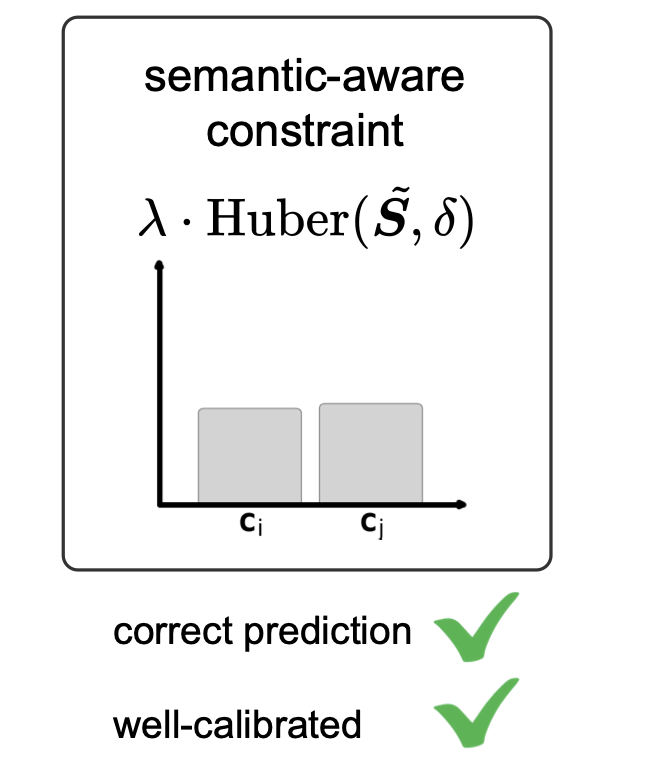 SoC: Semantic Orthogonal Calibration for Test-Time Prompt TuningLeo Fillioux, Omprakash Chakraborty, Ismail Ben Ayed, and 4 more authorsCVPR, 2026
With the increasing adoption of vision-language models (VLMs) in critical decision-making systems such as healthcare or autonomous driving, the calibration of their uncertainty estimates becomes paramount. Yet, this dimension has been largely underexplored in the VLM test-time prompt-tuning (TPT) literature, which has predominantly focused on improving their discriminative performance. Recent state-of-the-art advocates for enforcing full orthogonality over pairs of text prompt embeddings to enhance separability, and therefore calibration. Nevertheless, as we theoretically show in this work, the inherent gradients from fully orthogonal constraints will strongly push semantically related classes away, ultimately making the model overconfident. Based on our findings, we propose Semantic Orthogonal Calibration (SoC), a Huber-based regularizer that enforces smooth prototype separation while preserving semantic proximity, thereby improving calibration compared to prior orthogonality-based approaches. Across a comprehensive empirical validation, we demonstrate that SoC consistently improves calibration performance, while also maintaining competitive discriminative capabilities.
-
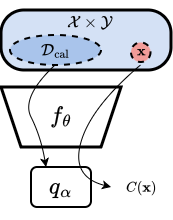 Are foundation models for computer vision good conformal predictors?Leo Fillioux, Julio Silva-Rodríguez, Ismail Ben Ayed, and 4 more authorsTMLR, 2026
Recent advances in self-supervision and contrastive learning have brought the performance of foundation models to unprecedented levels in a variety of tasks. Fueled by this progress, these models are becoming the prevailing approach for a wide array of real-world vision problems, including risk-sensitive and high-stakes applications. However, ensuring safe deployment in these scenarios requires a more comprehensive understanding of their uncertainty modeling capabilities, which has been barely explored. In this work, we delve into the behaviour of vision and vision-language foundation models under Conformal Prediction (CP), a statistical framework that provides theoretical guarantees of marginal coverage of the true class. Across extensive experiments including popular vision classification benchmarks, well-known foundation vision models, and three CP methods, our findings reveal that foundation models are well-suited for conformalization procedures, particularly those integrating Vision Transformers. We also show that calibrating the confidence predictions of these models, a popular strategy to improve their uncertainty quantification, actually leads to efficiency degradation of the conformal set on adaptive CP methods. Furthermore, few-shot adaptation of Vision-Language Models (VLMs) to downstream tasks, whose popularity is surging, enhances conformal scores compared to zero-shot predictions. Last, our empirical study exposes APS as particularly promising in the context of vision foundation models, as it does not violate the marginal coverage guarantees across multiple challenging, yet realistic scenarios.
-
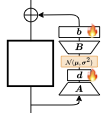 PVeRA: Probabilistic Vector-Based Random Matrix AdaptationLeo Fillioux, Enzo Ferrante, Paul-Henry Cournède, and 2 more authorsWACV, 2026
Large foundation models have emerged in the last years and are pushing performance boundaries for a variety of tasks. Training or even finetuning such models demands vast datasets and computational resources, which are often scarce and costly. Adaptation methods provide a computationally efficient solution to address these limitations by allowing such models to be finetuned on small amounts of data and computing power. This is achieved by appending new trainable modules to frozen backbones with only a fraction of the trainable parameters and fitting only these modules on novel tasks. Recently, the VeRA adapter was shown to excel in parameter-efficient adaptations by utilizing a pair of frozen random low-rank matrices shared across all layers. In this paper, we propose PVeRA, a probabilistic version of the VeRA adapter, which modifies the low-rank matrices of VeRA in a probabilistic manner. This modification naturally allows handling inherent ambiguities in the input and allows for different sampling configurations during training and testing. A comprehensive evaluation was performed on the VTAB-1k benchmark and seven adapters, with PVeRA outperforming VeRA and other adapters.
2025
-
 THUNDER: Tile-level Histopathology image UNDERstanding benchmarkPierre Marza, Leo Fillioux, Sofiène Boutaj, and 6 more authorsNeurIPS D&B track (Spotlight), 2025
Progress in a research field can be hard to assess, in particular when many concurrent methods are proposed in a short period of time. This is the case in digital pathology, where many foundation models have been released recently to serve as feature extractors for tile-level images, being used in a variety of downstream tasks, both for tile- and slide-level problems. Benchmarking available methods then becomes paramount to get a clearer view of the research landscape. In particular, in critical domains such as healthcare, a benchmark should not only focus on evaluating downstream performance, but also provide insights about the main differences between methods, and importantly, further consider uncertainty and robustness to ensure a reliable usage of proposed models. For these reasons, we introduce THUNDER, a tile-level benchmark for digital pathology foundation models, allowing for efficient comparison of many models on diverse datasets with a series of downstream tasks, studying their feature spaces and assessing the robustness and uncertainty of predictions informed by their embeddings. THUNDER is a fast, easy-to-use, dynamic benchmark that can already support a large variety of state-of-the-art foundation, as well as local user-defined models for direct tile-based comparison. In this paper, we provide a comprehensive comparison of 23 foundation models on 16 different datasets covering diverse tasks, feature analysis, and robustness.
-
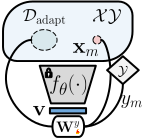 Full Conformal Adaptation of Medical Vision-Language ModelsJulio Silva-Rodríguez, Leo Fillioux, Paul-Henry Cournède, and 4 more authorsIPMI (Oral), 2025
Vision-language models (VLMs) pre-trained at large scale have shown unprecedented transferability capabilities and are being progressively integrated into medical image analysis. Although its discriminative potential has been widely explored, its reliability aspect remains overlooked. This work investigates their behavior under the increasingly popular split conformal prediction (SCP) framework, which theoretically guarantees a given error level on output sets by leveraging a labeled calibration set. However, the zero-shot performance of VLMs is inherently limited, and common practice involves few-shot transfer learning pipelines, which cannot absorb the rigid exchangeability assumptions of SCP. To alleviate this issue, we propose full conformal adaptation, a novel setting for jointly adapting and conformalizing pre-trained foundation models, which operates transductively over each test data point using a few-shot adaptation set. Moreover, we complement this framework with SS-Text, a novel training-free linear probe solver for VLMs that alleviates the computational cost of such a transductive approach. We provide comprehensive experiments using 3 different modality-specialized medical VLMs and 9 adaptation tasks. Our framework requires exactly the same data as SCP, and provides consistent relative improvements of up to 27% on set efficiency while maintaining the same coverage guarantees.
2023
- Spatio-Temporal Analysis of Patient-Derived Organoid Videos Using Deep Learning for the Prediction of Drug EfficacyLeo Fillioux, Emilie Gontran, Jérôme Cartry, and 7 more authorsICCV workshop, 2023
Over the last ten years, Patient-Derived Organoids (PDOs) emerged as the most reliable technology to generate ex-vivo tumor avatars. PDOs retain the main characteristics of their original tumor, making them a system of choice for pre-clinical and clinical studies. In particular, PDOs are attracting interest in the field of Functional Precision Medicine (FPM), which is based upon an ex-vivo drug test in which living tumor cells (such as PDOs) from a specific patient are exposed to a panel of anti-cancer drugs. Currently, the Adenosine Triphosphate (ATP) based cell viability assay is the gold standard test to assess the sensitivity of PDOs to drugs. The readout is measured at the end of the assay from a global PDO population and therefore does not capture single PDO responses and does not provide time resolution of drug effect. To this end, in this study, we explore for the first time the use of powerful large foundation models for the automatic processing of PDO data. In particular, we propose a novel imaging-based high-throughput screening method to assess real-time drug efficacy from a time-lapse microscopy video of PDOs. The recently proposed SAM algorithm for segmentation and DINOv2 model are adapted in a comprehensive pipeline for processing PDO microscopy frames. Moreover, an attention mechanism is proposed for fusing temporal and spatial features in a multiple instance learning setting to predict ATP. We report better results than other non-time-resolved methods, indicating that the temporality of data is an important factor for the prediction of ATP. Extensive ablations shed light on optimizing the experimental setting and automating the prediction both in real-time and at a more distant horizon.
- Structured State Space Models for Multiple Instance Learning in Digital PathologyLeo Fillioux, Joseph Boyd, Maria Vakalopoulou, and 2 more authorsMICCAI, 2023
Multiple instance learning is an ideal mode of analysis for histopathology data, where vast whole slide images are typically annotated with a single global label. In such cases, a whole slide image is modelled as a collection of tissue patches to be aggregated and classified. Common models for performing this classification include recurrent neural networks and transformers. Although powerful compression algorithms, such as deep pre-trained neural networks, are used to reduce the dimensionality of each patch, the sequences arising from whole slide images remain excessively long, routinely containing tens of thousands of patches. Structured state space models are an emerging alternative for sequence modelling, specifically designed for the efficient modelling of long sequences. These models invoke an optimal projection of an input sequence into memory units that compress the entire sequence. In this paper, we propose the use of state space models as a multiple instance learner to a variety of problems in digital pathology. Across experiments in metastasis detection, cancer subtyping, mutation classification, and multitask learning, we demonstrate the competitiveness of this new class of models with existing state of the art approaches.